
WDA Continues Participation in New Taipei City Animal Protection Committee to Advance Local Animal Governance in Taiwan

The Taiwan Representative of the World Dog Alliance (WDA) has once again been appointed to serve as a member of the New Taipei City Animal Protection Committee, continuing WDA's active involvement in discussing and advising on local government animal protection policies. For WDA, advancing animal protection goes beyond advocacy and education; it encompasses participating in public decision-making through formal institutional channels, thereby fostering a more comprehensive animal protection governance mechanism jointly established by the government, experts, and civil society organizations.
The New Taipei City Animal Protection Committee was formerly known as the "Fur Baby Happiness Committee." In response to the gradual expansion of animal protection policies, it was officially renamed the "New Taipei City Animal Protection Committee" in 2024. According to the Regulations for the Establishment of the New Taipei City Animal Protection Committee, the committee comprises professionals from diverse fields, including representatives from government agencies, animal protection and wildlife conservation groups, the veterinary community, legal and related academic experts, and pet industry associations. It is tasked with providing recommendations and consultations regarding animal protection policies, animal welfare in public shelters, and other related measures.
Although the committee formally convenes on a semi-annual basis, its true value lies not in the frequency of its meetings, but in its role as an open, institutionalized platform for dialogue. By bringing together committee members from various fields to discuss critical issues, the platform not only facilitates policy recommendations but also enables continuous monitoring of the outcomes of various animal protection initiatives. This ensures that the local government can balance professional expertise with public expectations when formulating and executing policies, thereby enhancing policy transparency and public participation.
Looking across Taiwan’s 22 counties and cities, only 9 local governments have currently established dedicated animal protection advisory (or deliberative) committees. These include Taipei City, New Taipei City, Taoyuan City, Taichung City, Tainan City, Kaohsiung City, Yilan County, Nantou County, and Hualien County. While several other counties and cities have stipulated the formation of such advisory committees within their local Animal Protection Autonomy Ordinances, they have yet to officially implement and establish them. This disparity demonstrates that the maturity of local animal protection efforts depends not merely on the existence of legal regulations, but on whether a continuous, multi-stakeholder mechanism for policy discussion has been established.
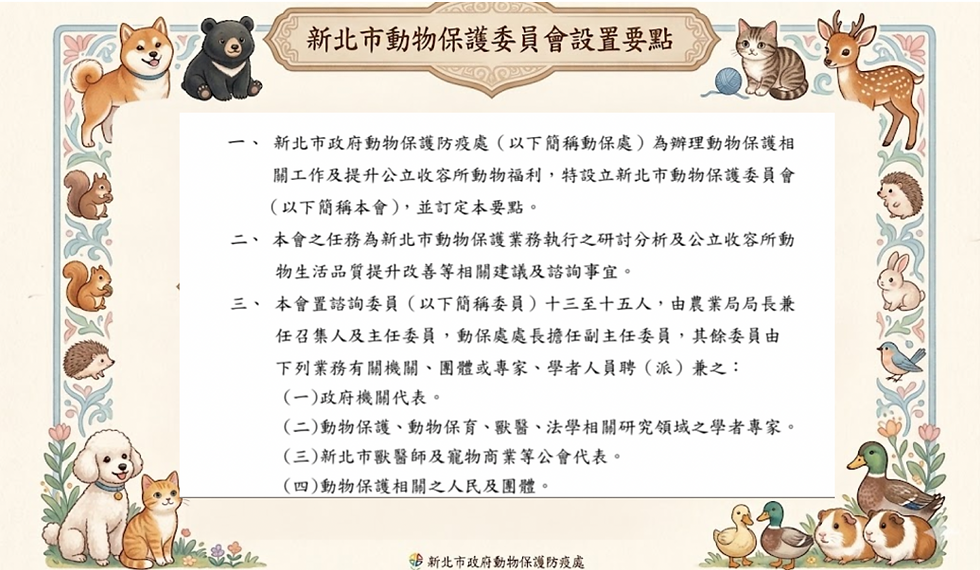
It is precisely for this reason that the World Dog Alliance has specifically included the "establishment of an animal protection advisory committee" as a key evaluation metric in its "Animal Friendly City Awards." WDA believes that a robust animal protection system involves more than just enacting laws or increasing budgets; it fundamentally requires a governance platform where both the government and the public actively participate. When academic experts, veterinarians, industry representatives, animal protection groups, and government departments can engage in sustained institutional exchange, local policies become more professional and better aligned with society's expectations for animal welfare.
Moving forward, alongside its ongoing participation in local government animal protection committees, WDA will continue to encourage more local governments to establish comprehensive animal protection advisory systems through the Animal Friendly City Awards and various exchange activities. By transforming public participation into a driving force for elevating animal welfare, WDA aims to collectively guide Taiwan toward a more compassionate and mature model of animal protection governance.


Comments