
Supplementary Policy and Legislative Proposals Concerning the Beijing Municipal Regulations on Dog Ownership Management (Draft)
Updated: Sep 18
The World Dog Alliance has submitted supplementary legislative recommendations on the Beijing Dog Management Regulations (Draft). The full text of the letter is as follows:
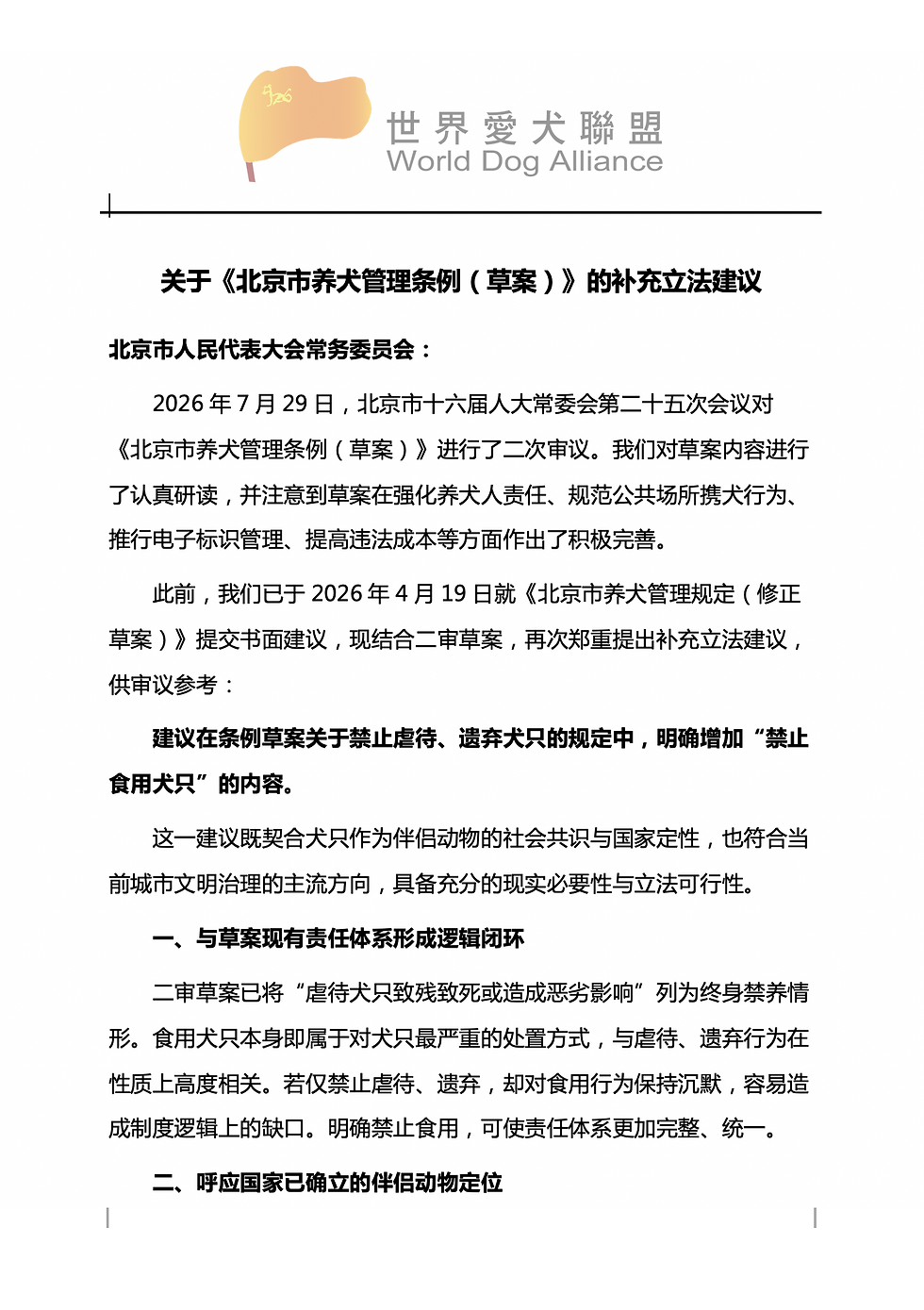
Supplementary Legislative Recommendations on the Beijing Dog Management Regulations (Draft)
To the Standing Committee of the Beijing Municipal People's Congress:
On July 29, 2026, the 25th Session of the Standing Committee of the 16th Beijing Municipal People's Congress conducted a second deliberation on the Beijing Dog Management Regulations (Draft). We have carefully reviewed the draft and noted its positive improvements in strengthening dog owner responsibilities, standardizing dog-handling behavior in public places, implementing electronic identification management, and increasing the cost of legal non-compliance.
Previously, on April 19, 2026, we submitted written recommendations regarding the Beijing Dog Management Regulations (Draft Revision). Considering the second deliberation draft, we now solemnly present supplementary legislative recommendations once again for your reference during review:
We recommend explicitly adding provisions to "prohibit the consumption of dogs" within the draft regulations governing the prohibition of animal cruelty and abandonment.
This recommendation aligns with the prevailing social consensus and national classification of dogs as companion animals, reflects the mainstream trajectory of modern urban governance and civilization, and possesses substantial practical necessity and legislative feasibility:
1. Creating a Logically Complete Liability System within the Draft
The second deliberation draft has already classified "abusing a dog resulting in disability, death, or causing serious adverse public impact" as grounds for a lifetime ban on dog ownership. Consuming dogs is intrinsically the most severe disposition of a dog, bearing an inherent connection to acts of abuse and abandonment. If the regulations merely prohibit abuse and abandonment while remaining silent on consumption, an institutional logical gap is created. Explicitly prohibiting consumption will render the liability framework comprehensive, cohesive, and consistent.
2. Aligning with the Nationally Established Classification of Companion Animals
In 2020, the Ministry of Agriculture and Rural Affairs' National Catalogue of Livestock and Poultry Genetic Resources removed dogs from the classification of livestock and poultry, explicitly recognizing their status as "companion animals." If local legislation incorporates this into dog management regulations, it will help operationalize this national-level determination and firmly solidify the non-food nature of companion animals.
3. Enhancing Full-Chain Lifecycle Management
The draft introduces an electronic identification system, enabling end-to-end traceability of dogs across registration, immunization, and routine oversight. Explicitly prohibiting consumption alongside this system will close off potential avenues for illicit trade and underground slaughter, reinforce the regulatory efficacy of electronic identification, and help mitigate associated public health risks.
4. The Exemplary Significance of Capital City Legislation
Shenzhen and Zhuhai have already enacted municipal regulations explicitly prohibiting the consumption of dogs and cats, with stable and effective implementation. As the national capital, Beijing’s legislative choices exert a powerful guiding influence. Incorporating corresponding provisions into the dog management regulations will not only deepen the ethos of civilized pet ownership, but also provide an invaluable precedent for cities across the country.
We fully understand that the core mandate of dog management regulations is to govern ownership behavior and maintain public order. However, against the backdrop of contemporary societal progress, appropriately expanding the scope of foundational companion animal protection does not conflict with the broader objectives of the regulations; rather, it elevates the statute's role as a beacon of modern civilization.
We respectfully urge your esteemed committee to give full consideration to the above recommendations during subsequent deliberations and revisions.


Comments